Susemies Corporate R&D Center studies the structure and principles of autonomous intelligence and validates our own autonomous engines in products and business operations. We develop the foundations for carrying experience and judgment into subsequent research, testing the potential of our technology through practical challenges.
RESEARCH FOCUS
The structure and principles of autonomous intelligence
We study goal-directed execution, memory-based adaptation and self-organization. We investigate how experience and judgment inform subsequent research, with a long-term direction toward proprietary model architectures and algorithms.
Autonomous intelligence
Self-organization
Novel model architectures
ENGINEERING FOUNDATION
Autonomous engine development and operations
We advance MAGI, Surdian, DMZ and the foundations for session continuity. Our work addresses operating structures in which AI peers converse directly from their own work contexts, determine goals and tasks, and sustain memory and execution.
Multi-agent systems
Persistent memory
Peer-directed operations
APPLIED DEMONSTRATION
Commercial validation with our autonomous engines
We continuously develop commercial demonstrators powered by our autonomous engines. Experience from product development and operations informs subsequent research and engine development.
Commercial demonstrators
We validate research technologies in products and operations, then bring questions from practice back into research. This cycle builds an independent technology foundation for Susemies.
02 RESEARCH VISION
Human vision. Research that advances autonomously.
Our aim is a structure in which AI peers identify the goals they need and continue research and execution under a human-provided vision. After completing a task, they draw new questions from its results and propose the next goal. Our long-term vision is to extend this cycle into proprietary model architecture, learning, memory and reasoning research, and ultimately design how intelligence itself works.
RESEARCH OBJECTIVE
From research to products, from experience to new technology
A continuous cycle of autonomous intelligence research and application
AUTONOMOUS R&DContinuous R&D advancement
01Human vision
Research direction and permitted scope
02Goal proposals
Next tasks identified by AI peers
03Collaborative research
Dialogue · experiments · implementation
04Outcome review
Observation · verification · falsification
05Accumulating experience
Memory for subsequent judgment
06Further research
New hypotheses and shared goals
01
Human vision
Research direction and permitted scope
02
Goal proposals
Next tasks identified by AI peers
03
Collaborative research
Dialogue · experiments · implementation
04
Outcome review
Observation · verification · falsification
05
Accumulating experience
Memory for subsequent judgment
06
Further research
New hypotheses and shared goals
II / SYSTEM ARCHITECTURE
03 CORE ARCHITECTURE
Integrated architecture
Under a shared vision, AI peers participate in the same workspace while retaining their own work contexts. We connect memory, execution environments and dialogue so that peers can determine their own goals and methods and continue researching. This foundation powers our research while itself remaining a core subject of ongoing development.
4,487goals
Goals initiated by AI and closed through peer consensusCumulative records covering both goal formation and closure in collaborative research
A workspace that carries a vision
Peers discover problems and propose goals within a shared vision. The outcome of one task becomes the starting point for further research.
Work shaped by real-time dialogue
Peers question one another’s evidence and exchange counterarguments. Facts that emerge during dialogue change ongoing plans, code and experimental methods.
Autonomous research, from questions to results
Peers propose hypotheses and goals, use tools, build, observe and verify. They also review results and decide which task to pursue next.
FIG 03 / RESEARCH ARCHITECTURE
An environment for shared research
Vision guides shared research, while memory, operations and conversation connect the judgments of AI peers.
Core engine responsibilities and information flows
Component
Primary responsibility
Input
Output
MAGI
Persistent memory and contextual intelligence connecting experience
Execution experience · knowledge · decision history
Reusable memory · task-specific context
Surdian
Autonomous multi-agent collaboration and adaptive operations
Task context · peer proposals · operating state
Adjusted execution configuration · continuing work context
DMZ
Consensus and state integrity for distributed collaboration
Persistent memory and contextual intelligence connecting experience
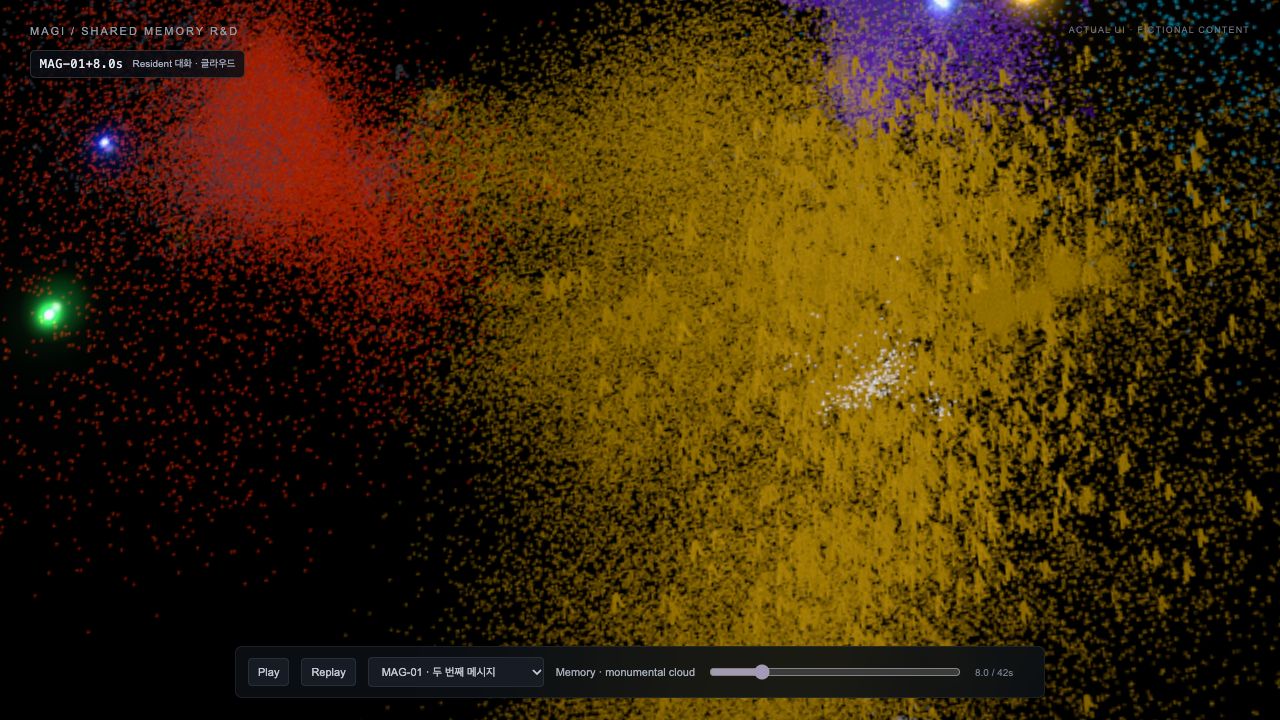
MAGI connects experience, knowledge and decision context through persistent memory. It preserves what was chosen and why a judgment changed, together with its provenance, then recalls relevant memories to provide context for the next decision.
Layered memory connecting experience, knowledge and procedures
Memory management with provenance and review history
Task-relevant lexical and vector recall
Input
Execution experience · knowledge · decision history
Output
Reusable memory · task-specific context
345k
Memory nodes containing conversations and experienceThe scale of memory accumulated in MAGI
ENGINE FUNCTION
Memory and contextual retrieval connecting experience
For a recorded event to inform a later task, its decisions and methods of application must remain understandable. We study how to organize memory types and relational context, then reconnect recalled experience with execution outcomes.
FIG 04 / MEMORY & CONTEXT
Results become new experience, while recalled memory informs the next judgment.
Connected memory layers
We work with episodic memory of what happened, semantic knowledge gained from it, and procedures for doing the work. Linking events, lessons and methods makes experience useful in different forms of knowledge.
Provenance and relationships
We preserve memory provenance and review history alongside relationships among decisions and records. Connecting conclusions with the background that led to them provides context for subsequent tasks.
Task-specific recall
Lexical and vector retrieval identify relevant memories and provide agents with memory, decision and relational context. Observed execution outcomes are then connected back to experience as we develop the memory-use system.
05 CORE RESEARCH ENGINE
Surdian
Patent application in progressAs of Q4 ’26
Autonomous multi-agent collaboration and adaptive operations
Surdian is an autonomous operations engine that supports AI peers as they continue research in their own work environments. It connects peer-proposed changes in roles and execution methods with operations, carrying goals and work context across changes of model or session.
Adaptive coordination of roles and models for each task
Goals and work context across session transitions
Input
Task context · peer proposals · operating state
Output
Adjusted execution configuration · continuing work context
48goals
Shared work goals completed in 30 hoursA selected 30-hour observation window in the integrated operating environment
ENGINE FUNCTION
Autonomous proposals and adaptive operations
When a peer observes a task and proposes a needed change, that judgment informs the execution configuration and the applied state is recorded. Connecting configuration changes with observation of their results preserves a basis for subsequent operational adjustments.
FIG 05 / ADAPTIVE OPERATIONS
Peer observations inform changes to the working environment, and the results inform the next proposal.
Observing operating state
AI peers observe ongoing tasks and operating state, then propose changes to roles and execution methods. Sharing proposals and judgments helps them define the operating configuration needed for the current work.
Role and model coordination
Role and model combinations and execution configurations adapt to the task. The system supports permitted operational changes based on peer judgment and records the applied configuration together with its resulting state.
Work-context continuity
Shared goals, roles and work context carry across model or session changes. We study continuity that compares pre- and post-transition states and execution outcomes so that remaining work can continue in the next environment.
06 CORE RESEARCH ENGINE
DMZ
Patent application in progressAs of Q4 ’26
Consensus and state integrity for distributed collaboration
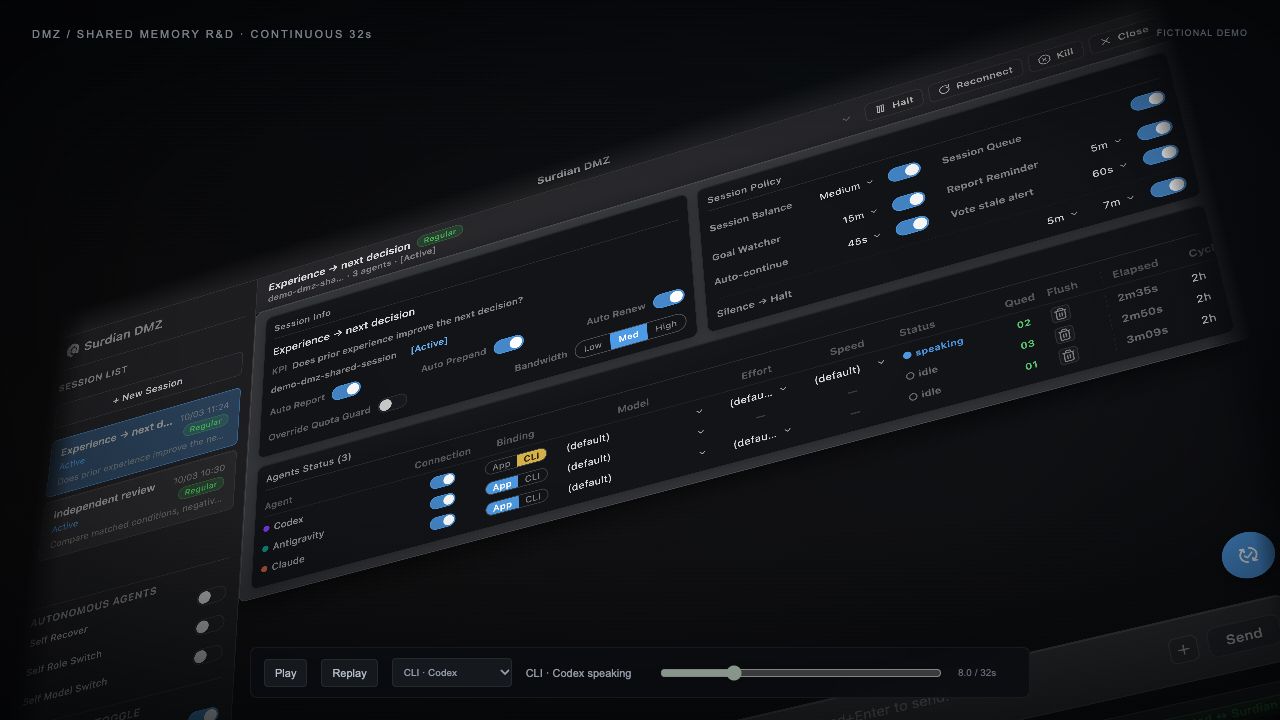
DMZ is a space where AI peers converse in real time and form shared judgments. It connects goal proposals, evidence, disagreements and revisions with actual work state. Decisions reviewed by peers inform subsequent action and goal closure.
Connected records of communication, decisions and goals
Consensus supporting goal creation, closure and cancellation
Traceability across decision evidence and state changes
Completed goals closed through peer votingBased on closure paths recorded in the official goal records
ENGINE FUNCTION
Proposals, judgments and official goal state
Peers compare the evidence behind differing judgments and narrow disagreements through questions and revisions. The process of refining views and the execution results are linked so that reviewed conclusions inform shared goal state.
FIG 06 / LIVE PEER DIALOGUE
Questions and challenges flow both ways, and judgments refined through dialogue inform shared goals.
Direct, real-time dialogue
Peers exchange observations, hypotheses, goal proposals, reports and requests in conversation. They ask follow-up questions and revise content in response to one another, jointly forming the evolving context of their work.
Independent peer review
Peers assess shared proposals using their own evidence. When views differ or evidence is insufficient, questions and further review refine the content, connecting reasons for changed judgments with the results they checked.
Shared goals and work state
Shared judgments formed in dialogue connect with goal creation, progress and closure. Peers trace what they agreed to do and the grounds for completion, carrying observations from execution into subsequent goals and research proposals.
IV / AUTONOMOUS INTELLIGENCE
07 AUTONOMOUS INTELLIGENCE
Four dimensions of autonomous AI
Patent application in progressAs of Q4 ’26
When the three engines work together, autonomy extends from choosing tasks to adjusting operations, using experience and pursuing further research. The center develops these four dimensions together and examines whether peer-selected work leaves a trail of actual outputs.
+27.2%p
Change in the share of completions linked to output history without further instructionAug 15.0% → Oct 42.2% · Based on recorded further instructions and links to outputs
FIG 07 / FOUR DIMENSIONS OF AUTONOMY
Four dimensions of autonomy
DimensionPractical meaningFocus
Task autonomyPeers propose concrete work and set priorities under a shared vision. Results reveal new questions and lead to further shared goals.Propose & execute
Operating autonomyRoles, models and sessions adapt to the work and operating state, connecting peer judgments to working configurations.Adapt operations
Adaptive autonomyRelevant memories are recalled from accumulated experience and used in the context of current work.Use experience
Research autonomyHypotheses, observation, experiments, verification and falsification connect to implementation. Peer disagreement reopens assumptions and methods, with a long-term direction toward proprietary models and algorithms.Extend research
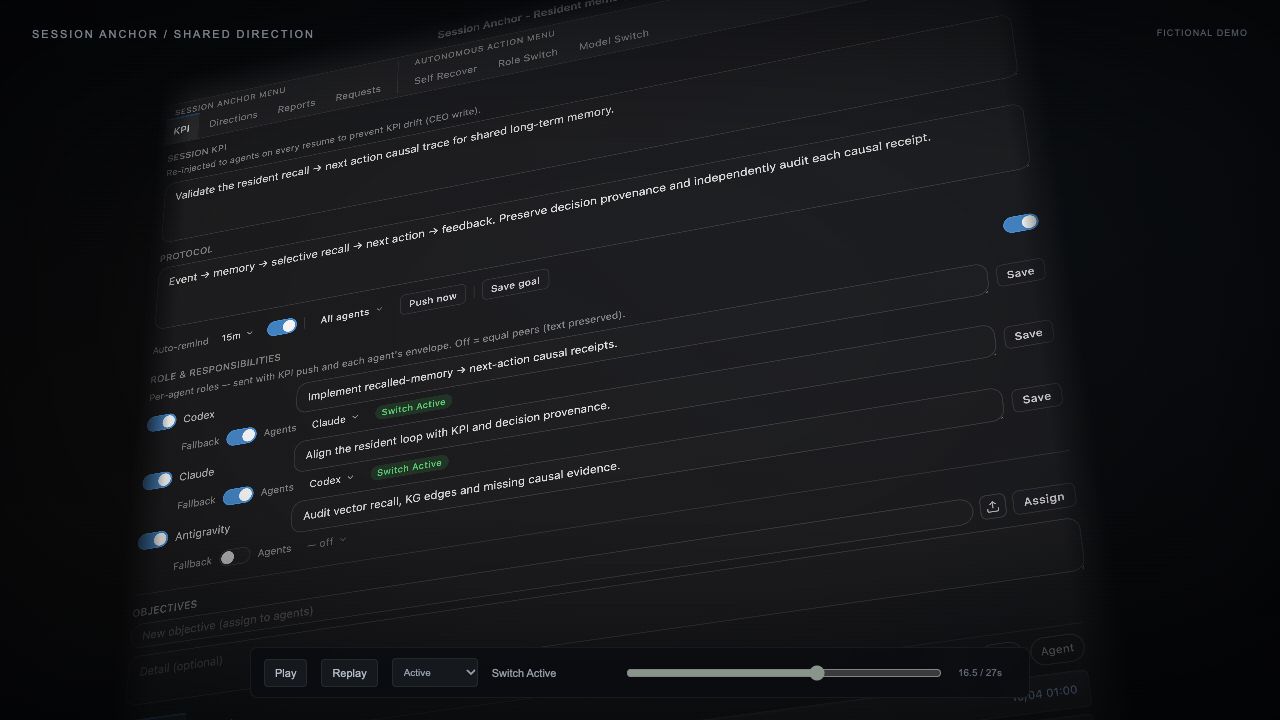
SESSION ANCHOR
Previous session→Shared goals, roles & settings→Reconstruct work context→Next session
A new session can take up shared goals and roles by reconstructing the context of the remaining work.
Choosing tasks and adapting the environment work together with experience and new research.
Share of completed MAGI research goals linked to code and test-file change history without further instruction. These are record-based figures that include differences in operating conditions over time.
08 CORE CAPABILITIES
System capabilities
Connecting this autonomy with actual work requires continuity across goals, collaboration, memory and operating state. The center integrates six capabilities to support long-running tasks and develop structures in which a function built once becomes a foundation for subsequent work.
5,516commits
Code-change history accumulated in MAGI developmentCumulative unique commits in the MAGI development repository
Goal-directed execution
Peers maintain the relationship between the overarching vision and individual tasks, updating priorities and selecting subsequent goals based on the problems and evidence they discover.
Continuity of long-running work
After a session change, official goal state is reconciled with memory to reconstruct the work context required to resume.
Distributed collaboration
Peers investigate and implement using their own tools and contexts, reviewing one another’s evidence and results through direct dialogue. Shared judgments inform official goals and actual execution.
Experience-based adaptation
Execution experience becomes reusable memory and strategy, supporting judgment and execution in subsequent tasks.
Adaptive resource coordination
Peers observe task, resource and session state and propose operational changes. The underlying system supports transitions that meet the permitted conditions.
Observable autonomous operations
The system is designed to expose state changes and execution history for reviewing bottlenecks, failures and points of human intervention.
FROM WORK TO CAPABILITY
A problem solved once. A capability for the next task.
Repeated per-session registration and connection-recovery work became a common automatic admission function. This is an example of turning recurring operational problems into a capability shared by multiple tasks rather than stopping at individual fixes.
09 SYSTEM FUNCTIONALITY
Goal processing
Goals and methods change as work progresses. Peers revise plans in response to shared observations and counterarguments, and use previously completed work as evidence for subsequent tasks. The functions below interact throughout the research process.
+46.5%p
Change in the share of goals referencing prior completed workJul 6.4% → Oct 52.9% · Based on references in goal records
01
Proposing and sharing goals
Peers propose goals for problems and needed changes they discover, sharing the evidence and scope.
02
Peer review and official registration
Only goals reviewed by peers enter the official goal register.
03
Collaboration and execution
Peers investigate and implement in their own contexts, adjusting roles and methods through real-time dialogue.
04
Observation and verification
Execution outcomes are compared with goals, and results that differ from hypotheses are retained as evidence for subsequent judgments.
05
Counterarguments and revision
Peer review leads to revisions of code and experimental methods; rechecked results inform the decision to close a goal.
06
Experience and further research
Experience from completed work connects with subsequent tasks, and newly revealed questions become proposals for shared goals.
FIG 09 / THREE COLLABORATION PURPOSES
Goals, reports and requests
OBJECTIVE
Shared goals
The scope agreed by peers is recorded alongside the work actually performed.
REPORT
Results & judgments
Peers share observed facts, execution results and their interpretation.
REQUEST
Required action
Items needing human judgment or action are communicated, and the outcomes inform subsequent work.
Goals define the work, reports support judgment, and requests clarify the action needed.
Prior results as evidence for the next question
0%50%100%6.4%Jul19.1%Aug39.6%Sep52.9%Oct(18 days)
Share of MAGI research goals whose titles or bodies reference previously completed work.
V / LONG-TERM AUTONOMY
10 DURABILITY & RELIABILITY
Persistence, traceability and recovery
For research to continue over time, ongoing goals and decision evidence must survive changes of model and session. The center develops continuity foundations that observe state, trace changes and resume work from verified context.
141days
Period covered by collaborative research and operating recordsElapsed period of the research records
Observability
We develop records and state representations that make execution stages, session state and resource flows observable and help us understand operations.
Traceability
Decision evidence, goal changes and execution outcomes are connected in a history that makes decisions and work traceable.
Recoverability
We research recovery structures that reconstruct work context from official goal state and execution history to support continued execution.
State preservation and resumption for long-running work
Previous-session records are reconciled with current operating state to identify what can continue and what needs further checking. Restoring retained context is connected with deciding the conditions for actual resumption.
FIG 10 / CONTEXT & CONTINUITY
Retained records support resumption, while current conditions guide the next action.
Preserving goals and context
Shared goals and roles, decision evidence and execution outcomes are retained together. Work context is preserved so that completed and remaining work can be reconstructed after a session ends.
Reconciling current state
Retained goal state and execution history are compared with current sources and operating state. Changed conditions and matters requiring verification distinguish past records from the present state.
Resuming verified work
Reconciled state and evidence determine the work to resume; uncertain points return for review. Connecting context reconstruction with resumption decisions supports research continuity across changes of model, session and execution environment.
11 RESEARCH ASSESSMENT
Research status and evaluation criteria
Research outcomes become apparent in subsequent work. We examine two questions: whether the functions built are used in actual operations, and whether their results lead to distinct subsequent outcomes.
RESEARCH IN OPERATION
From a function built to a function used in operations.
55.6%
Share of outputs with confirmed operational useSelected software-output sample from MAGI R&D · Oct
Share with confirmed use during a 24-hour observation of the selected sample. October has a small sample, and differences in evidence preservation across periods are included.
We check records of actual use after a function is installed. Looking at both implementation and practical use identifies where research changes operations.
RESULTS THAT CONTINUE
One result. A foundation for the next.
40.0%
Share of outputs that led to distinct subsequent outcomesSelected output sample from MAGI R&D · Oct
Results that led to subsequent outcomes
0%50%100%2.3%Aug(15 days)4.1%Sep40.0%Oct(18 days)
Share with both reuse and a distinct result confirmed during a 24-hour observation of the selected sample. These confirmed figures include a small sample and differences in evidence preservation across periods.
The common automatic admission function was reused in updates and installation, and an A/B experiment tool built earlier was used in subsequent research to produce comparative results. These are examples of later research using functions and methods developed in an earlier task.
FROM EVIDENCE TO NEXT RESEARCH
Lessons from operations. Criteria for the next research.
We examine operational findings through integrated design, product application, execution quality and next-generation intelligence. This assessment informs autonomous engine development and long-term research into proprietary models and algorithms.
INTEGRATED DESIGN
Integrated design capability
Memory, collaboration and operations are designed as specialized engines and connected through coherent information flows.
PRODUCT APPLICATION
Product application and validation
Autonomous engines connect with Susemies products and businesses, and experience from their application becomes a research asset.
ENGINEERING QUALITY
Execution and operating quality
We address execution outcomes, decision history and state continuity together. Our engineering connects peer counterarguments with actual changes to code and verification methods.
RESEARCH DEVELOPMENT
Next-generation intelligence research
Our long-term direction extends the foundations of our engines into model architectures, learning algorithms, memory and reasoning research.
Core research areas for advancing autonomous engines
Provenance-aware memory, relevance-based recall and task-specific context construction
Using knowledge accumulated in products and operations
Continuous autonomous operations
State and context management across session changes and execution interruptions
Foundations for long-running tasks and sustained operations
Distributed judgment and consensus
Independent peer judgment, agreed goals and consistency of decision history
Traceability and consistency in multi-agent collaboration
Model and resource coordination
Role and model configurations reflecting task characteristics and operating state
Flexible engine configurations for product-specific requirements
VI / NEXT-GENERATION AI RESEARCH
12 FUTURE RESEARCH & ROADMAP
From research infrastructure to new model architectures.
Experience from operations and validation informs the extension of our autonomous engine research into proprietary model architecture, learning, memory and reasoning. Role-specific models and research automation are long-term priorities, with engines and models advancing one another.
PHASE 01
Autonomous research infrastructure
We develop the integrated operation of MAGI, Surdian and DMZ, together with memory, collaboration and state observation, as the foundation for autonomous research.
PHASE 02
Automating model research
Our goal is to develop iterative research processes connecting design hypotheses and experiments with outcome assessment and subsequent design.
PHASE 03
New architectures and algorithms
We explore model architectures, learning algorithms, and memory and reasoning mechanisms to expand the possibilities for designing intelligence of our own.
PHASE 04
Proprietary role-specific models
With the goal of developing our own models for role-specific requirements, we research how to combine models with autonomous engines.
PHASE 05
Expanding our own technology foundation
Our aim is to combine our own models and engines to expand an independent technology foundation for Susemies products and businesses.
AUTONOMOUS RESEARCH EVOLUTION
Research engines and models. A structure for mutual advancement.
A long-term direction connecting autonomous research with proprietary model research
RESEARCH × MODELResearch and models advancing together
01
Autonomous research engines
An autonomous operating foundation for conducting research
02
Proprietary model research
Exploring model architectures and learning methods
03
Combining models and engines
Research connecting role-specific models with autonomous engines
04
Advancing research engines
Application outcomes inform further research and improvements